Publication

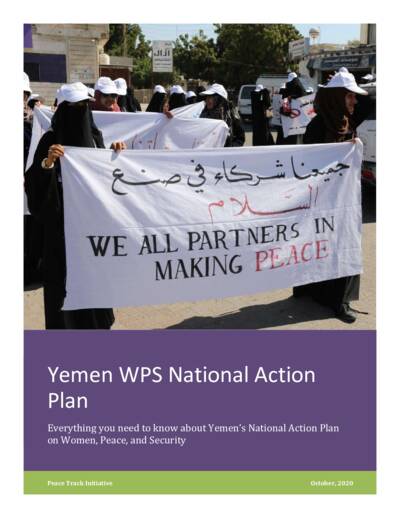
Yemen’s WPS National Action Plan

In October 2020, the Peace Track Initiative published a comprehensive analysis of Yemen’s National Action Plan (NAP) on Women, Peace, and Security (WPS), marking a critical milestone in the country’s efforts to advance gender equality amid conflict. Developed by the Yemeni government with limited civil society input, the NAP represents a formal commitment to UNSC Resolution 1325 but falls short of addressing the urgent and intersectional needs of Yemeni women. This document traces the NAP’s evolution—from its roots in the 2016 National Agenda for WPS, led by Yemeni women leaders, to its approval in 2019—while highlighting glaring gaps: inadequate gender analysis, exclusion of civil society voices, and a lack of concrete implementation strategies. The report also showcases how women-led organizations have tirelessly filled these gaps through grassroots peacebuilding, humanitarian mediation, and advocacy, despite systemic exclusion. With actionable recommendations for the Yemeni government, donors, and international partners, this analysis serves as a roadmap to strengthen the NAP, ensuring it reflects the realities of Yemeni women and aligns with global frameworks like CEDAW and the Beijing Platform.  
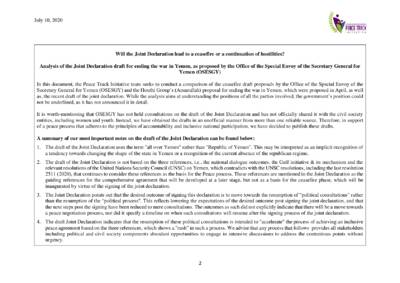
Will the Joint Declaration lead to a ceasefire or a continuation of hostilities?

An analysis of the Joint Declaration draft for ending the war in Yemen, as proposed by the Office of the Special Envoy of the Secretary General for Yemen (OSESGY)   In this document, the Peace Track Initiative team seeks to conduct a comparison of the ceasefire draft proposals by the Office of the Special Envoy of the Secretary General for Yemen (OSESGY) and the Houthi Group’s (Ansarullah) proposal for ending the war in Yemen, which were proposed in April, as well as, the recent draft of the joint declaration. While the analysis aims at understanding the positions of all the parties involved, the government’s position could not be underlined, as it has not announced it in detail. It is worth-mentioning that OSESGY has not held consultations on the draft of the Joint Declaration and has not officially shared it with the civil society entities, including women and youth. Instead, we have obtained the drafts in an unofficial manner from more than one reliable source. Therefore, in support of a peace process that adheres to the principles of accountability and inclusive national participation, we have decided to publish these drafts.  

A lexicon on hate speech in Yemen

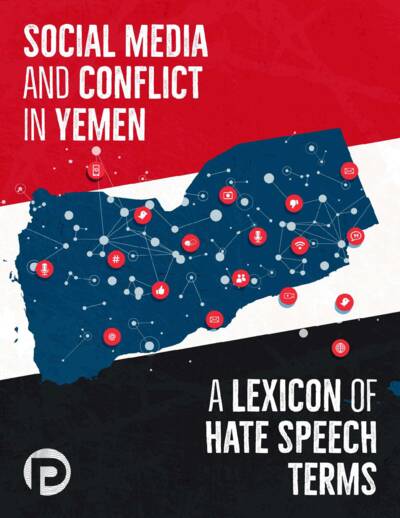
PeaceTech Lab, Peace Track Initiative, and Development Transformations have partnered to produce “Yemen: A Lexicon of Hate Speech Terms” which is a tool that stakeholders can use to identify and curb the use of specific hate speech terms on Yemen’s social media platforms to help bring an end to violence.

Yemen WPS National Agenda for 2016

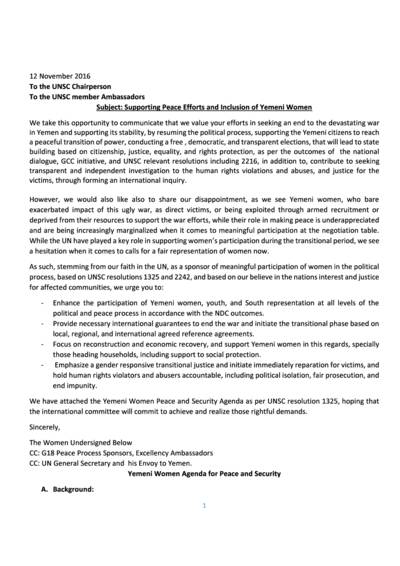
I In 2016, over 70 Yemeni women leaders collaborated to develop the Yemeni Women’s Agenda for Peace and Security (WPS National Agenda)—a policy-oriented document outlining key recommendations for inclusive peace, justice, and post-conflict recovery in Yemen. Addressed to the UN Security Council, peace process facilitators, and international actors, the agenda proposes a 30% quota for women’s participation, the protection of women and girls from gender-based violence, disarmament initiatives, economic inclusion, and transitional justice mechanisms that consider gender dimensions. It also underscores the importance of integrating the needs of women and children into peace negotiations, humanitarian aid, and reconstruction plans, in line with UN Security Council Resolutions 1325 and 2242. Recognized by the UN Security Council in June 2017, the agenda remains a reference point for efforts aimed at achieving inclusive and lasting peace in Yemen. The full document outlines Yemeni women’s contributions to peacebuilding and efforts toward gender equality.